
Your car’s factory warranty won’t last forever, and the terms aren’t the same for every vehicle. Maybe your car is a few months from its third birthday, or the odometer is close to 36,000 miles, and you’re wondering whether to buy more protection or wait.
This guide explains the bumper-to-bumper vs. powertrain warranty question in plain terms and covers when it may make sense to look at an extended warranty.
Bumper-to-Bumper vs. Powertrain Warranty: The Difference
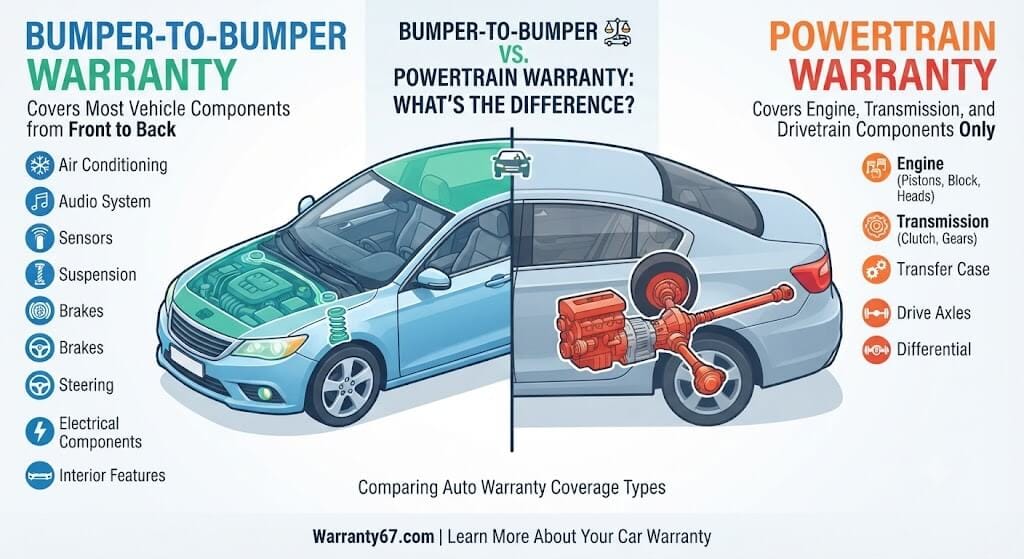
Most new vehicles come with several types of factory warranty coverage. Two of the most common are bumper-to-bumper and powertrain warranties. They cover different parts of the vehicle and may have different time or mileage limits.
What Does a Bumper-to-Bumper Warranty Cover?
A bumper-to-bumper warranty, often called a basic or limited warranty, generally covers many vehicle components, subject to the manufacturer’s exclusions and terms. Depending on the manufacturer, that can include electrical components, air conditioning, and infotainment and sensor systems.
The name is a little misleading. Bumper-to-bumper warranty coverage doesn’t include everything. Tires, brake pads, wiper blades, and routine maintenance are typically left out. Your owner’s warranty booklet lists the exact exclusions.
What Does a Powertrain Warranty Cover?
A powertrain warranty generally covers major components that deliver power to the wheels, such as the engine, transmission, and drivetrain. The exact components covered depend on the manufacturer and warranty terms. These are some of the most expensive parts to repair, and powertrain coverage often lasts longer than basic coverage.
Some manufacturers use terms such as 3 years/36,000 miles for basic coverage and 5 years/60,000 miles for powertrain coverage, but warranty terms vary by manufacturer, model, and vehicle. Always check the warranty documents for the exact limits.
| Feature | Bumper-to-Bumper Warranty | Powertrain Warranty |
| Parts generally covered | Many components, including electronics and A/C | Engine, transmission, drivetrain |
| Typical length | Usually shorter | Usually longer |
| Common exclusions | Wear items, maintenance, cosmetic damage | Parts outside the powertrain |
| Where to confirm details | Owner’s warranty booklet | Owner’s warranty booklet |
Why Your Warranty Expiration Date Matters
Factory warranties commonly have both time and mileage limits, with coverage ending when the applicable limit is reached. Check your warranty documents for the exact terms.
Each warranty has its own limits, so basic coverage may end before powertrain coverage does. In that gap, a failed sensor or A/C compressor may be your bill, even if the engine and transmission are still covered.
What Is an Extended Warranty?
What people often call an “extended warranty” is frequently a vehicle service contract. These contracts are optional and can cover certain repairs or services described in the contract after, or sometimes alongside, the manufacturer’s warranty. A service contract isn’t technically the same as a manufacturer’s warranty, and it isn’t auto insurance.
Your car insurance policy, with its liability, collision, and comprehensive coverage, generally responds to accidents, theft, and certain other events. A service contract is aimed at mechanical breakdowns. Neither replaces the other, and terms vary by insurer, state, and provider.
When Is the Best Time to Buy an Extended Warranty?
There’s no single right answer, but the months before your factory coverage ends are a sensible time to start comparing.
Before the Factory Warranty Ends
It can be easier to compare your options while the factory warranty is still active. You have time to look at different plans and see what each one actually covers. Keep in mind that not every vehicle will qualify for the same plans, and prices and waiting periods can be different from one provider to another.
It’s also worth checking whether you’re already covered before buying anything. If the factory warranty would pay for a repair, you may not need a service contract that covers the same part during the same period. Check when the new coverage would start and exactly which repairs or components are included.
After the Factory Warranty Ends
You can still buy a service contract later in many cases. Eligibility, coverage levels, and pricing may be different, though, and some contracts have waiting periods or require an inspection first.
| Situation | What to Consider |
| Basic coverage ending, powertrain coverage continues | Compare plans that add coverage beyond the powertrain |
| Factory warranty already expired | Check eligibility, waiting periods, and vehicle requirements |
| High annual mileage | Find out whether time or miles will run out first |
What to Check Before You Buy
These are general points, not personal advice.
- How long you’ll keep the car. More years of ownership means more time for repairs to come up.
- The contract itself. Read what’s covered, what’s excluded, and what the deductible is.
- Repair location. Some contracts require a qualified repair facility, while others give you more choice.
- Claim process. Ask how a repair claim is submitted, authorized, and paid under the contract.
- Total cost. Add the contract price and deductible, then compare it to the coverage.
Common Mistakes and Tips
- Assuming “bumper-to-bumper” means everything. Always read the exclusions.
- Waiting until something breaks. Problems that already exist are typically not covered.
- Mixing up a service contract and car insurance. They cover different things.
- Skipping the fine print. Deductibles, limits, and claim rules matter.
- Letting maintenance records slide. Some contracts require maintenance to follow the manufacturer’s recommendations, and records can matter when you file a claim.
- Buying under pressure. A “limited-time” pitch or an urgent “your warranty is expiring” call is a reason to slow down.
Why It Matters
Knowing how your coverage works lets you plan instead of react. You can spot gaps early and compare options calmly. No contract can promise you’ll avoid repair costs, but understanding your options can make them easier to manage.
Key Takeaways
- Bumper-to-bumper warranties cover more parts but often end sooner than powertrain warranties.
- Powertrain warranties focus on the engine, transmission, and drivetrain.
- Factory warranties commonly have both time and mileage limits, so check your documents.
- An extended warranty is typically a service contract, not car insurance.
- Comparing options before your factory coverage ends gives you more time to decide.
Frequently Asked Questions
Does a powertrain warranty cover the transmission?
Generally, yes, but the specific covered parts vary by manufacturer, so check your warranty booklet.
Will my car insurance pay for repairs after the warranty ends?
Standard auto insurance generally doesn’t cover ordinary mechanical breakdowns. Policies vary by insurer and state, so review yours.
Can I buy an extended warranty after the factory warranty expires?
In many cases, yes. Some providers sell service contracts for vehicles whose manufacturer’s warranties have already expired, but eligibility, coverage, and waiting periods vary.
Do factory warranties transfer to the next owner?
Many do, but some come with conditions. Your warranty booklet or a dealership can tell you what applies to your vehicle.
Do I have to buy an extended warranty from the dealer?
Not necessarily. Service contracts can come from dealers, manufacturers, or independent providers, so compare the terms.
Need Help Understanding Your Coverage Options?
Every driver and vehicle is a little different, so the coverage that makes sense for one person may not be the same for someone else. If you’re not sure what type of coverage you need or want to go over your options, our team is here to help.
Conclusion
The difference comes down to what each warranty covers and how long it lasts. Know your expiration dates, read the fine print, and compare options early. This is general information only, so review your own documents and speak with a qualified professional about your situation.